Goethe’s Faust—Is Photography the Ultimate Answer to Human Aspirations?
Goethe’s Faust is currently being performed at the Volkstheater in Vienna, directed by Kay Voges. The play is introduced with a quote from Henri Cartier-Bresson: “In photography, as elsewhere, the moment is its own question and, at the same time, its own answer.” A live photographer is part of the ensemble. Reason enough to take a closer look.
So here I am, sitting in a red velvet armchair in the lavishly decorated Volkstheater, eagerly anticipating the show. As a young adult, I really enjoyed the book *Faust 1*; I liked the language, the mysticism, and yet the worldly themes of love, knowledge, and the meaning of life. Goethe’s *Faust* is no stranger to stages around the world, and all the more reason it can—or even must—be staged more freely and adapted to our times.
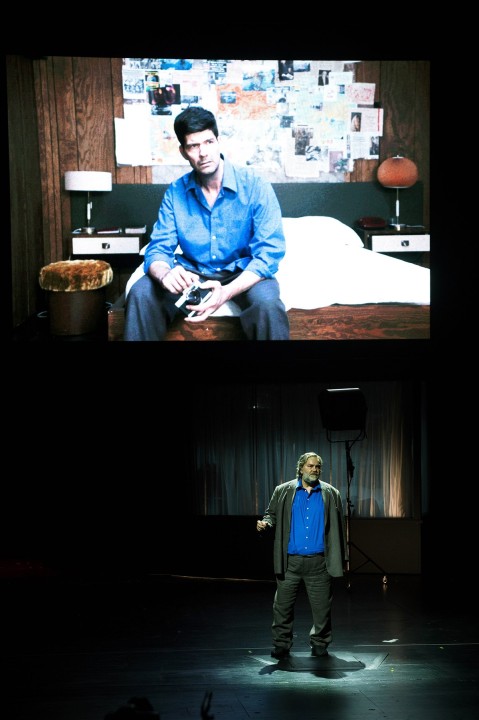
The Photographer as Part of the Production
The photographer, Marcel Urlaub, is introduced right at the beginning of the play during the prologue in the theater. For those who no longer remember their high school graduation days: the theater director, a poet, and the jester are arguing about a successful play. The photographer walks between them (or was he one of the three characters?). He wears casual, modern black clothing and does not speak. With bright flashes and sound effects, he takes photos of the audience. The sudden brightness takes everyone by surprise. A murmur ripples through the audience. People rub their eyes and are instantly wide awake again.
Through the photograph, the viewer becomes part of the performance
Shortly thereafter, the photographed faces of the audience are projected onto a screen on stage, magnified to several meters in size. Laughter and amazement now ripple through the audience. The photograph captures the diverse faces and their expressions in this unusual situation: seated in the theater and unprepared to contribute to the play or to be photographed from the safety of their theater seats. Now the viewer, as a photograph, becomes part of the play. “Don’t stare so romantically,” it seems to call out to the audience here—you, too, are meant by this; you, too, are in this moment; you were in this moment.
Photography Instead of Drama
Throughout the play, photography is also used to depict Gretchen’s beauty (played by 3 to 4 people in this production) or even to intensely stage an orgy scene—set to rock music—featuring Faust and the many Gretchens: The photos—each a standalone image in its own right, each reimagined and redesigned—even allow an entire scene to be replaced by photography until the actor playing Faust stumbles out from behind the screen with his shirt open and takes over the narrative on stage.
Even more variations on the use of photography can be found throughout the play—as a parallel narrative, as set design, to increase tension and much more.
A New Perspective on an Old Play
The book certainly offers plenty of material for contemporary connections, but for me, bringing photography into the picture is more than just a visual, compulsively modern concept. The parallels between Faust and photography have real substance for me. After giving it a great deal of thought, this perspective holds up and adds an undeniably contemporary dimension to the interpretation of both the play and photography.
The old Doctor Faust has studied everything, amassed knowledge from so many fields, and yet he is not satisfied. He is desperately searching for the meaning and joy of human life. “Shall I say to the moment: Stay a while! You are so beautiful! Then you may bind me in chains; then I will gladly perish!” With these words, Goethe enters into a pact with Mephisto.
Yet we all know that nothing in this world lasts forever. Even the most beautiful moment is fleeting. A photograph can evoke memories and emotions—but the intellect understands: that moment has passed. Nevertheless, we accumulate images today just as Faust accumulated knowledge. To me, translating the Faustian pursuit of the Enlightenment into today’s media age is a perceptive parallel and a social statement. Humanity—nearly 200 years after the invention of photography and nearly 200 years after the premiere of *Faust*—strives, through Instagram or a pact with the devil, through photographs or knowledge, to combat its own transience and that of the moment.
Conclusion
Definitely check it out—and don’t forget your selfie stick! 😉
A few follow-up questions
Questions Without Answers—That, Too, Is Something Humans Can Endure
As a mass phenomenon, is photography our modern-day attempt to capture all human striving and transience? Can photography truly capture the (beautiful) moment? Can photography give meaning to life? Would Goethe never have written *Faust* if he’d known about photography? Would Faust be a photographer, influencer, and digital nomad with barista skills today? Would Faust be despairing today over how many photos he already has on his hard drive, yet still hasn’t seen the whole world, and how life’s moments remain fleeting and he never “arrives”?